
Germany
ISO2: DE
German citizenship by naturalization (Einbürgerung) through residence: minimum residence period, permanent/long-term residence right requirement, qualifying permits, documents, submission workflow, official sources, and dual citizenship policy.
Passport
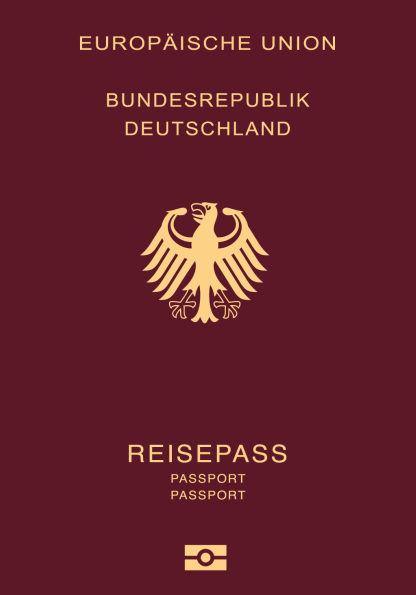
Citizenship by residence
- Minimum years of residence
- 5.0
- Requires permanent residence
- Yes
- Last updated
- Feb. 18, 2026
- Notes
- Standard entitlement naturalization generally requires 5 years of lawful habitual residence. A prior 3-year accelerated route for exceptional integration was removed effective 30 Oct 2025; plan around 5 years unless eligible under a different legal provision (e.g., spouse/registered partner of a German citizen). At the time of naturalization, applicants generally must hold an unlimited/permanent or long-term right of residence (e.g., Niederlassungserlaubnis, EU long-term residence, EU/EEA free-movement right, Swiss agreement residence) or a residence title designed to lead to permanent stay (BAMF also lists EU Blue Card and certain temporary permits depending on purpose). Typical additional requirements include clarified identity, commitment to the free democratic basic order, sufficient German (often B1), knowledge test (Einbürgerungstest / Leben in Deutschland), self-support without reliance on certain means-tested benefits (with exceptions in practice), and no serious criminal convictions. Exact document checklists and local process steps vary by Bundesland/municipality.
- Dual citizenship
-
Dual citizenship: Allowed
Renunciation required: No
- Notes for dual citizenship
- Germany generally allows dual/multiple citizenship. Since the modernized nationality law effective 27 June 2024, naturalization no longer generally requires renouncing the previous nationality, and German citizens acquiring another nationality by application no longer need a retention permit to keep German nationality.
Qualifying residence permits
Aufenthaltserlaubnis – employment (Skilled worker / general employment titles designed for long-term stay)
Temporary permit can qualify if its purpose is designed to lead to long-term stay; final assessment by local authority.
Counts
Aufenthaltserlaubnis – family reunification
Often designed for long-term stay; may qualify depending on the underlying legal basis and continuity.
Counts
Aufenthaltserlaubnis – self-employment
Can qualify if designed for long-term stay and requirements are met; final assessment by local authority.
Counts
Aufenthaltserlaubnis – study / education only
Purely temporary education purposes may not meet the “designed for long-term stay” requirement; local authority rules and individual situation matter.
Doesn’t count
Blaue Karte EU (EU Blue Card)
Official guidance lists the EU Blue Card as a qualifying status in the residence-right category.
Counts
Erlaubnis zum Daueraufenthalt-EU (EU long-term residence)
Unlimited EU long-term residence; generally satisfies the long-term residence-right requirement.
Counts
EU/EEA citizenship – Freizügigkeitsrecht (right of free movement) with habitual residence in Germany
EU/EEA nationals typically rely on free-movement residence rights rather than a residence permit; evidence is assessed by the local authority.
Counts
Niederlassungserlaubnis (settlement permit / permanent residence)
Unlimited/permanent residence status; generally satisfies the long-term residence-right requirement at time of naturalization.
Counts
Short-stay visa / tourist stay
Does not count as long-term lawful residence for the naturalization residence clock.
Doesn’t count
Swiss nationals – residence under the Swiss–EU agreement (Aufenthalt nach Freizügigkeitsabkommen)
Swiss agreement residence is referenced as qualifying in official guidance.
Counts
Required documents
| Document | Mandatory | Notes |
|---|---|---|
|
Birth certificate (and, if applicable, civil status certificates)
Birth certificate and, where relevant, marriage certificate, registered partnership certificate, divorce decree, spouse documents, children birth certificates, etc.
|
Mandatory | Provide civil status documents as applicable (marriage/partnership/divorce/children). |
|
Civics/knowledge proof (Einbürgerungstest / Leben in Deutschland)
Certificate proving knowledge of the legal and social order and living conditions in Germany (test-based in most cases).
|
Mandatory | Typically required; proof is usually via Einbürgerungstest/LiD certificate (authority rules apply). |
|
German language proof (typically B1)
Certificate or recognized evidence of German language skills (commonly B1), subject to exemptions in certain cases.
|
Mandatory | Language requirement commonly B1; exemptions can apply in limited cases (authority-specific handling). |
|
German naturalization application (Einbürgerungsantrag)
Application form required by the competent local naturalization authority (Einbürgerungsbehörde / Staatsangehörigkeitsbehörde).
|
Mandatory | Application submitted to the competent local naturalization authority; formats/portals vary by Bundesland/municipality. |
|
Health insurance proof
Proof of health insurance coverage (statutory or private).
|
Mandatory | Provide evidence of health insurance coverage. |
|
Proof of income / self-support (employment, tax, etc.)
Documents showing ability to support yourself and dependents without relying on certain means-tested social benefits, subject to exceptions.
|
Mandatory | Demonstrate ability to support yourself and dependents without certain means-tested benefits; exceptions may exist in practice. |
|
Residence status proof (permit / permanent right of residence)
Evidence of the qualifying residence title or long-term right of residence at the time of naturalization (e.g., Niederlassungserlaubnis, Daueraufenthalt-EU, EU/EEA free-movement, Swiss agreement, EU Blue Card, etc.).
|
Mandatory | At the time of naturalization, a permanent/long-term residence right (or qualifying long-term status) is generally required; authority verifies eligibility. |
|
Valid passport / travel document + proof of identity
Passport and identity documents; identity and current nationality must be clarified.
|
Mandatory | Identity and current nationality must be clarified; additional documents may be requested depending on the case. |
|
Proof of residence/registration (Anmeldung/Meldebescheinigung) and address history
Local registration certificate and residence history where requested by the authority.
|
Optional | Often requested by local authority to confirm habitual residence and address history; some checks may be done internally. |
Submission offices
BAMF – Naturalization information (guidance + requirements overview)
Online
Official federal guidance page (overview). Not a submission office, but a key official entry point to requirements and process.
Local naturalization authority (Einbürgerungsbehörde / Staatsangehörigkeitsbehörde) for your place of residence
Municipal / Civil Registry
Primary competent authority. Responsibility is local (city/district/kreis) and procedures/portals vary by Bundesland/municipality.
Official sources
BAMF – Einbürgerung (English overview)
Government
Federal Office guidance: standard 5-year rule and core requirements overview.
en
BAMF – Einbürgerung (German overview)
Government
Federal Office guidance in German; includes residence-right wording and key requirements list.
de
BMI – Einbürgerung (overview + requirements)
Government
Federal Interior Ministry overview: requirements including permanent/long-term residence right and procedure pointers.
de
Federal Foreign Office – new nationality law (27 June 2024) and multiple citizenship
Government
Official statement that since 27 June 2024 acquisition of a foreign nationality no longer requires losing German nationality; retention permit removed.
en
Federal Government – Cabinet update (30 Oct 2025): 3-year acceleration removed
Government
Confirms removal of the 3-year accelerated naturalization option effective 30 Oct 2025; 5 years remain the standard.
de
Federal Government – modernization of nationality law (27 June 2024)
Government
Overview of modernization incl. general acceptance of multiple citizenship and the reduced residence period framework.
de
Gesetze-im-Internet – Staatsangehörigkeitsgesetz (StAG) § 10
Law / Regulation
Legal basis for standard entitlement naturalization; sets the 5-year lawful habitual residence requirement.
de
Gesetze-im-Internet – Staatsangehörigkeitsgesetz (StAG) § 9
Law / Regulation
Legal basis for spouse/registered partner of a German citizen: generally 3 years residence + 2 years marriage/partnership.
de
Latest ranking snapshot
As of Feb. 22, 2026
- Travel freedom185.00
- Residency rights31.00
- Quality of life196.30
- Economic freedom71.60
- Tax friendliness20.00
Methodology (as of 2026-02-22): composite ranking uses weighted, min-max normalized scores across (1) Travel freedom 25% from Henley Passport Index 2026 (visa-free/visa-on-arrival count), (2) Economic freedom 25% from Heritage Index of Economic Freedom 2025 (overall score), (3) Residency rights 20% proxy based on free-movement blocs (EU+EEA+Switzerland highest; Mercosur medium; others baseline), (4) Disposable income after taxes 20% from Numbeo Average Monthly Net Salary (After Tax), USD, (5) Quality of life 5% from Numbeo Quality of Life Index 2026, (6) Tax friendliness 5% from Nomad Passport Index (Taxation column only). Raw indicator values are stored in this table; composite scoring is computed externally.